Showing posts with label gate 2011. Show all posts
Showing posts with label gate 2011. Show all posts
Tags:- gate,gate 2011,gate papers,gate cs papers,gate answer key,gate cs 1991 answer key,gate cs 1991 paper,gate papers solution,gate mock papers,gate test papers,gate test series
GATE CS - 1991
SECTION – A
1. Fill in the blanks:SECTION – A
(i) For the digital in figure, the expression for the output f is _________
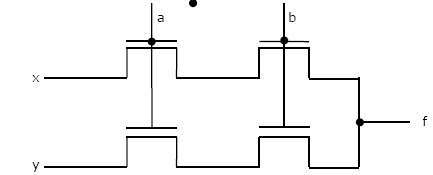
Solution
ii) In interleaved memory organization, consecutive words are stored in
consecutive memory modules in ________ interleaving, whereas consecutive words are stored within the module in ________ interleaving.
(iii) Consider the number given by the decimal expression:
16^3*9 + 16^2*7 + 16*5 + 3
The number of 1‘s in the unsigned binary representation of the number is
________.
(iv) Using the 8087 arithmetic coprocessor with the 8087 CPU requires that the 8087 CPU is operated ________.
(v) When two 4-bit binary number A=a0 a1 a2 a3 B=b0 b1 b2 b3 are multiplied,
the digit c1 of the product C is given by _________
(vi) Consider the following PASCAL program segment:
if i mode 2 = 0 then
while i > = 0 do
begin
i:=i div 2;
if i mod 2 < > 0 do then i:=i - 1
else i:=i - 2
end
An appropriate loop-invariant for the while-loop is ______
(vii) The minimum number of comparisons required to sort 5 elements is _____
(viii) The weighted external path length of the binary tree in figure is _____

(ix)If the binary tree in figure is traversed in inorder, then the order in which the nodes will be visited is ______

(x)Consider the following recursive definition of fib:
fib (n) : = if n = 0 then 1
else if n = 1 than 1
else fib (n - 1) + fib ( n - 2)
The number of times fib is called (including the first call) for an evaluation of
fib (7) is ___________
(xi) The arithmetic expression :(a+b)*c-d/e**f is to be evaluated on two- address machine, where each operands, the number of registers required to evaluate this expression is ______. The number of memory access of operand is __________.
(xii) A given set of processes can be implemented by using only
statement, if the precedence graph of these processes is parbegin/parend
________
(xiii) The number of integer-triples (i.j.k) with 1<=i.j.k<=300 such that i + j + k is divisible by 3 is ________
(xiv) If the longest chain in a partial order is of length n then the partial order can be written as a ______ of n antichains.
(xv) The maximum number of possible edges in an undirected graph with a vertices and k components is ________.
Match the pairs in the following questions by writing the corresponding letters only.
(i)
(A) IEEE 488 (P) specifies the interface for connecting a single device
(B) IEEE 796 (Q) specifies the bus standard for connecting a computer to other devices including CPU‘s
(C) IEEE 696 (R) specifies the standard for an instrumentation bus
(D) RS232-C (S) specifies the bus standard for the —backplane“ bus called multibus.
(ii)
For the 8086 microprocessor:
(A) RQ/GT (P) Used by processor for holding the bus for consecutive instruction cycles.
(B) LOCK (Q) Used for extending the memory or I/O cycle times
(C) HOLD (R) Used for getting hold of processor bus in minimum bus mode
(D) READY (S) Used for requesting processor bus in minimum bus mode.
(iii)
(A) Buddy system (P) Run-time type specification
(B) Interpretation (Q) Segmentation
(C) Pointer type (R) Memory allocation
(D) Virtual memory (S) Garbage collection
3. Choose the correct alternatives (more than one may be correct) and write the corresponding letters only:
(i) The advantages of CMOS technology over a MOS is:
(a) lower power dissipation
(b) greater speed
(c) smaller chip size
(d) fewer masks for fabrication
(e) none of the above
(ii) Advantage of synchronous sequential circuits over asynchronous ones is:
(a) faster operation
(b) ease of avoiding problems due to hazards
(c) lower hardware requirement
(d) better noise immunity
(e) none of the above
(iii) The total size of address space is a virtual memory systems is limited by
(a) the length of MAR
(b) the available secondary storage
(c) the available main memory
(d) all of the above
(e) none of the above
(iv) The TRAP interrupt mechanism of the 8085 microprocessor:
(a) executes an instruction supplied by an external device through the INTA ignal
(b) executes an instruction from memory location 20H
(c) executes a NOP
(d) none of the above
(v) The ALE line of an 8085 microprocessor is used to:
(a) latch the output of an I/O instruction into an external latch
(b) deactivate the chip-select signal from memory devices
(c) latch the 8 bits of address lines AD7-AD0 into an external latch
(d) find the interrupt enable status of the TRAP interrupt
(e) None of the above
vi) Kruskal‘s algorithm for finding a minimum spanning tree of a weighted graph G with vertices and m edges has the time complexity of:
(a) O(n^2)
(b) O(mn)
(c) O(m+n)
(d) O(mlogn)
(e) O(m^2)
(vii) The following sequence of operations is performed on a stack: PUSH (10), PUSH (20), POP, PUSH (10), PUSH (20), POP, POP, POP, PUSH (20), POP The sequence of values popped out is:
(a) 20, 10, 20, 10, 20
(b) 20, 20, 10, 10, 20
(c) 10, 20, 20, 10, 20
(d) 20, 20, 10, 20, 10
(ix) A —link editor“ is a program that:
(a) matches the parameters of the macro-definition with locations of the parameters of the macro call
(b) matches external names of one program with their location in other programs
(c) matches the parameters of subroutine definition with the location of parameters of subroutine call.
(d) acts as link between text editor and the user
(e) acts as a link between compiler and user program.
(x) Indicate all the true statements from the following:
(a) Recursive descent parsing cannot be used for grammar with left recursion.
(b) The intermediate form the representing expressions which is best suited for code optimization is the post fix form.
(c) A programming language not supporting either recursion or pointer type does not need the support of dynamic memory allocation.
(d) Although C does not support call by name parameter passing, the effect can be correctly simulated in C.
(e) No feature of Pascal violates strong typing in Pascal.
(xi) Indicate all the false statements from the statements given below:
(a) The amount of virtual memory available is limited by the availability of secondary storage.
(b) Any implementation of a critical section requires the use of an indivisible machine-instruction, such as test-and-set.
(c) The LRU page replacement policy may cause hashing for some type of programs.
(d) The best fit techniques for memory allocation ensures the memory will never be fragmented.
(xii) If F1,F2,F3 are propositional formulae such that F1^F2-->F3 and F1^F1-->~F2 Are both tautologies, then which of thefollowing is true:
(a) Both F1 and F2 are tautologies
(b) The conjunction F1^F2 is not satisfiable
(c) Neither is tautologous
(d) Neither is satisfiable
(e) None of the above
(xiv)Which one of the following is the strongest correct statement about a finite language over some finite alphabet
 ?
(a) It could be undecidable
(b) It is Turing-machine recognizable
(c) It is a context-sensitive language
(d) It is a regular language
(e) None of the above
Tags:-gate,gate 2011,gate 2011 syllabus,gate Production and Industrial Engineering - PI syllabus,gate study material,syllabus,gate 2011 mock test,gate test series,gate papers,gate materials
Gate 2011 Production and Industrial Engineering - PI Syllabus
ENGINEERING MATHEMATICS
Linear Algebra: Matrix algebra, Systems of linear equations, Eigen values and eigen vectors.ENGINEERING MATHEMATICS
Calculus: Functions of single variable, Limit, continuity and differentiability, Mean value theorems, Evaluation of definite and improper integrals, Partial derivatives, Total derivative, Maxima and minima, Gradient, Divergence and Curl, Vector identities, Directional derivatives, Line, Surface and Volume integrals, Stokes, Gauss and Green?s theorems.
Differential equations: First order equations (linear and nonlinear), Higher order linear differential equations with constant coefficients, Cauchy?s and Euler?s equations, Initial and boundary value problems, Laplace transforms, Solutions of one dimensional heat and wave equations and Laplace equation.
Complex variables: Analytic functions, Cauchy?s integral theorem, Taylor and Laurent series.
Probability and Statistics: Definitions of probability and sampling theorems, Conditional probability, Mean, median, mode and standard deviation, Random variables, Poisson, Normal and Binomial distributions.
Numerical Methods: Numerical solutions of linear and non-linear algebraic equations Integration by trapezoidal and Simpson?s rule, single and multi-step methods for differential equations.
GENERAL ENGINEERING
Engineering Materials: Structure and properties of engineering materials and their applications; effect of strain, strain rate and temperature on mechanical properties of metals and alloys; heat treatment of metals and alloys, its influence on mechanical properties.
Applied Mechanics: Engineering mechanics - equivalent force systems, free body concepts, equations of equilibrium; strength of materials - stress, strain and their relationship, Mohr?s circle, deflection of beams, bending and shear stress, Euler?s theory of columns.
Theory of Machines and Design: Analysis of planar mechanisms, cams and followers; governers and fly wheels; design of elements - failure theories; design of bolted, riveted and welded joints; design of shafts, keys, spur gears, belt drives, brakes and clutches.
Thermal Engineering: Fluid mechanics - fluid statics, Bernoulli?s equation, flow through pipes, equations of continuity and momentum; thermodynamics - zeroth, first and second law of thermodynamics, thermodynamic system and processes, calculation of work and heat for systems and control volumes; air standard cycles; basics of internal combustion engines and steam turbines; heat transfer - fundamentals of conduction, convection and radiation, heat exchangers.
PRODUCTION ENGINEERING
Metal Casting: Casting processes - types and applications; patterns - types and materials; allowances; moulds and cores - materials, making, and testing; casting techniques of cast iron, steels and nonferrous metals and alloys; solidification; design of casting, gating and risering; casting inspection, defects and remedies.
Metal Forming: Stress-strain relations in elastic and plastic deformation; concept of flow stress, deformation mechanisms; hot and cold working - forging, rolling, extrusion, wire and tube drawing; sheet metal working processes such as blanking, piercing, bending, deep drawing, coining and embossing; analysis of rolling, forging, extrusion and wire /rod drawing; metal working defects.
Metal Joining Processes: Welding processes - manual metal arc, MIG, TIG, plasma arc, submerged arc, electroslag, thermit, resistance, forge, friction, and explosive welding;other joining processes - soldering, brazing, braze welding; inspection of welded joints, defects and remedies; introduction to advanced welding processes - ultrasonic, electron beam, laser beam; thermal cutting.
Machining and Machine Tool Operations: Basic machine tools; machining processes-turning, drilling, boring, milling, shaping, planing, gear cutting, thread production, broaching, grinding, lapping, honing, super finishing; mechanics of machining - geometry of cutting tools, chip formation, cutting forces and power requirements, Merchant?s analysis; selection of machining parameters; tool materials, tool wear and tool life, economics of machining, thermal aspects of machining, cutting fluids, machinability; principles and applications of nontraditional machining processes - USM, AJM, WJM, EDM and Wire cut EDM, LBM, EBM, PAM, CHM, ECM.
Tool Engineering: Jigs and fixtures - principles, applications, and design; press tools - configuration, design of die and punch; principles of forging die design.
Metrology and Inspection: Limits, fits, and tolerances, interchangeability, selective assembly; linear and angular measurements by mechanical and optical methods, comparators; design of limit gauges; interferometry; measurement of straightness, flatness, roundness, squareness and symmetry; surface finish measurement; inspection of screw threads and gears; alignment testing of machine tools.
Powder Metallurgy: Production of metal powders, compaction and sintering.
Polymers and Composites: Introduction to polymers and composites; plastic processing - injection, compression and blow molding, extrusion, calendaring and thermoforming; molding of composites.
Manufacturing Analysis: Sources of errors in manufacturing; process capability; tolerance analysis in manufacturing and assembly; process planning; parameter selection and comparison of production alternatives; time and cost analysis; manufacturing technologies - strategies and selection.
Computer Integrated Manufacturing: Basic concepts of CAD, CAM, CAPP, cellular manufacturing, NC, CNC, DNC, Robotics, FMS, and CIM.
INDUSTRIAL ENGINEERING
Product Design and Development: Principles of good product design, tolerance design; quality and cost considerations; product life cycle; standardization, simplification, diversification, value engineering and analysis, concurrent engineering.
Engineering Economy and Costing: Elementary cost accounting and methods of depreciation; break-even analysis, techniques for evaluation of capital investments, financial statements.
Work System Design: Taylor?s scientific management, Gilbreths?s contributions; productivity - concepts and measurements; method study, micro-motion study, principles of motion economy; work measurement - stop watch time study, work sampling, standard data, PMTS; ergonomics; job evaluation, merit rating, incentive schemes, and wage administration; business process reengineering.
Facility Design: Facility location factors and evaluation of alternate locations; types of plant layout and their evaluation; computer aided layout design techniques; assembly line balancing; materials handling systems.
Production Planning and Inventory Control: Forecasting techniques - causal and time series models, moving average, exponential smoothing, trend and seasonality; aggregate production planning; master production scheduling; MRP and MRP-II; order control and flow control; routing, scheduling and priority dispatching; push and pull production systems, concept of JIT manufacturing system; logistics, distribution, and supply chain management; Inventory - functions, costs, classifications, deterministic and probabilistic inventory models, quantity discount; perpetual and periodic inventory control systems.
Operation Research: Linear programming - problem formulation, simplex method, duality and sensitivity analysis; transportation and assignment models; network flow models, constrained optimization and Lagrange multipliers; simple queuing models; dynamic programming; simulation - manufacturing applications; PERT and CPM, time-cost trade-off, resource leveling.
Quality Management: Quality - concept and costs, quality circles, quality assurance; statistical quality control, acceptance sampling, zero defects, six sigma; total quality management; ISO 9000; design of experiments - Taguchi method.
Reliability and Maintenance: Reliability, availability and maintainability; distribution of failure and repair times; determination of MTBF and MTTR, reliability models; system reliability determination; preventive maintenance and replacement, total productive maintenance - concept and applications.
Management Information System: Value of information; information storage and retrieval system - database and data structures; knowledge based systems.
Intellectual Property System: Definition of intellectual property, importance of IPR; TRIPS and its implications, patent, copyright, industrial design and trademark.
Tags:-gate,gate 2011,gate 2011 syllabus,gate MECHANICAL engineering syllabus,gate study material,syllabus,gate 2011 mock test,gate test series,gate papers,gate materials.
Linear Algebra: Matrix algebra, Systems of linear equations, Eigen values and eigen vectors.
Calculus: Functions of single variable, Limit, continuity and differentiability, Mean value theorems, Evaluation of definite and improper integrals, Partial derivatives, Total derivative, Maxima and minima, Gradient, Divergence and Curl, Vector identities, Directional derivatives, Line, Surface and Volume integrals, Stokes, Gauss and Green?s theorems.
Differential equations: First order equations (linear and nonlinear), Higher order linear differential equations with constant coefficients, Cauchy?s and Euler?s equations, Initial and boundary value problems, Laplace transforms, Solutions of one dimensional heat and wave equations and Laplace equation.
Complex variables: Analytic functions, Cauchy?s integral theorem, Taylor and Laurent series.
Probability and Statistics: Definitions of probability and sampling theorems, Conditional probability, Mean, median, mode and standard deviation, Random variables, Poisson, Normal and Binomial distributions.
Numerical Methods: Numerical solutions of linear and non-linear algebraic equations Integration by trapezoidal and Simpson?s rule, single and multi-step methods for differential equations.
Strength of Materials: Stress and strain, stress-strain relationship and elastic constants, Mohr?s circle for plane stress and plane strain, thin cylinders; shear force and bending moment diagrams; bending and shear stresses; deflection of beams; torsion of circular shafts; Euler?s theory of columns; strain energy methods; thermal stresses.
Theory of Machines: Displacement, velocity and acceleration analysis of plane mechanisms; dynamic analysis of slider-crank mechanism; gear trains; flywheels.
Vibrations: Free and forced vibration of single degree of freedom systems; effect of damping; vibration isolation; resonance, critical speeds of shafts.
Design: Design for static and dynamic loading; failure theories; fatigue strength and the S-N diagram; principles of the design of machine elements such as bolted, riveted and welded joints, shafts, spur gears, rolling and sliding contact bearings, brakes and clutches.
Heat-Transfer: Modes of heat transfer; one dimensional heat conduction, resistance concept, electrical analogy, unsteady heat conduction, fins; dimensionless parameters in free and forced convective heat transfer, various correlations for heat transfer in flow over flat plates and through pipes; thermal boundary layer; effect of turbulence; radiative heat transfer, black and grey surfaces, shape factors, network analysis; heat exchanger performance, LMTD and NTU methods.
Thermodynamics: Zeroth, First and Second laws of thermodynamics; thermodynamic system and processes; Carnot cycle. irreversibility and availability; behaviour of ideal and real gases, properties of pure substances, calculation of work and heat in ideal processes; analysis of thermodynamic cycles related to energy conversion.
Applications: Power Engineering: Steam Tables, Rankine, Brayton cycles with regeneration and reheat. I.C. Engines: air-standard Otto, Diesel cycles. Refrigeration and air-conditioning: Vapour refrigeration cycle, heat pumps, gas refrigeration, Reverse Brayton cycle; moist air: psychrometric chart, basic psychrometric processes. Turbomachinery: Pelton-wheel, Francis and Kaplan turbines ? impulse and reaction principles, velocity diagrams.
Metal Casting: Design of patterns, moulds and cores; solidification and cooling; riser and gating design, design considerations.
Forming: Plastic deformation and yield criteria; fundamentals of hot and cold working processes; load estimation for bulk (forging, rolling, extrusion, drawing) and sheet (shearing, deep drawing, bending) metal forming processes; principles of powder metallurgy.
Joining: Physics of welding, brazing and soldering; adhesive bonding; design considerations in welding.
Machining and Machine Tool Operations: Mechanics of machining, single and multi-point cutting tools, tool geometry and materials, tool life and wear; economics of machining; principles of non-traditional machining processes; principles of work holding, principles of design of jigs and fixtures
Metrology and Inspection: Limits, fits and tolerances; linear and angular measurements; comparators; gauge design; interferometry; form and finish measurement; alignment and testing methods; tolerance analysis in manufacturing and assembly.
Computer Integrated Manufacturing: Basic concepts of CAD/CAM and their integration tools.
Production Planning and Control: Forecasting models, aggregate production planning, scheduling, materials requirement planning.
Inventory Control: Deterministic and probabilistic models; safety stock inventory control systems.
Operations Research: Linear programming, simplex and duplex method, transportation, assignment, network flow models, simple queuing models, PERT and CPM.
ENGINEERING MATHEMATICS
Linear Algebra: Matrix algebra, Systems of linear equations, Eigen values and eigen vectors.
Calculus: Functions of single variable, Limit, continuity and differentiability, Mean value theorems, Evaluation of definite and improper integrals, Partial derivatives, Total derivative, Maxima and minima, Gradient, Divergence and Curl, Vector identities, Directional derivatives, Line, Surface and Volume integrals, Stokes, Gauss and Green?s theorems.
Differential equations: First order equations (linear and nonlinear), Higher order linear differential equations with constant coefficients, Cauchy?s and Euler?s equations, Initial and boundary value problems, Laplace transforms, Solutions of one dimensional heat and wave equations and Laplace equation.
Complex variables: Analytic functions, Cauchy?s integral theorem, Taylor and Laurent series.
Probability and Statistics: Definitions of probability and sampling theorems, Conditional probability, Mean, median, mode and standard deviation, Random variables, Poisson, Normal and Binomial distributions.
Numerical Methods: Numerical solutions of linear and non-linear algebraic equations Integration by trapezoidal and Simpson?s rule, single and multi-step methods for differential equations.
APPLIED MECHANICS AND DESIGN
Engineering Mechanics: Free body diagrams and equilibrium; trusses and frames; virtual work; kinematics and dynamics of particles and of rigid bodies in plane motion, including impulse and momentum (linear and angular) and energy formulations; impact.Strength of Materials: Stress and strain, stress-strain relationship and elastic constants, Mohr?s circle for plane stress and plane strain, thin cylinders; shear force and bending moment diagrams; bending and shear stresses; deflection of beams; torsion of circular shafts; Euler?s theory of columns; strain energy methods; thermal stresses.
Theory of Machines: Displacement, velocity and acceleration analysis of plane mechanisms; dynamic analysis of slider-crank mechanism; gear trains; flywheels.
Vibrations: Free and forced vibration of single degree of freedom systems; effect of damping; vibration isolation; resonance, critical speeds of shafts.
Design: Design for static and dynamic loading; failure theories; fatigue strength and the S-N diagram; principles of the design of machine elements such as bolted, riveted and welded joints, shafts, spur gears, rolling and sliding contact bearings, brakes and clutches.
FLUID MECHANICS AND THERMAL SCIENCES
Fluid Mechanics: Fluid properties; fluid statics, manometry, buoyancy; control-volume analysis of mass, momentum and energy; fluid acceleration; differential equations of continuity and momentum; Bernoulli?s equation; viscous flow of incompressible fluids; boundary layer; elementary turbulent flow; flow through pipes, head losses in pipes, bends etc.Heat-Transfer: Modes of heat transfer; one dimensional heat conduction, resistance concept, electrical analogy, unsteady heat conduction, fins; dimensionless parameters in free and forced convective heat transfer, various correlations for heat transfer in flow over flat plates and through pipes; thermal boundary layer; effect of turbulence; radiative heat transfer, black and grey surfaces, shape factors, network analysis; heat exchanger performance, LMTD and NTU methods.
Thermodynamics: Zeroth, First and Second laws of thermodynamics; thermodynamic system and processes; Carnot cycle. irreversibility and availability; behaviour of ideal and real gases, properties of pure substances, calculation of work and heat in ideal processes; analysis of thermodynamic cycles related to energy conversion.
Applications: Power Engineering: Steam Tables, Rankine, Brayton cycles with regeneration and reheat. I.C. Engines: air-standard Otto, Diesel cycles. Refrigeration and air-conditioning: Vapour refrigeration cycle, heat pumps, gas refrigeration, Reverse Brayton cycle; moist air: psychrometric chart, basic psychrometric processes. Turbomachinery: Pelton-wheel, Francis and Kaplan turbines ? impulse and reaction principles, velocity diagrams.
MANUFACTURING AND INDUSTRIAL ENGINEERING
Engineering Materials: Structure and properties of engineering materials, heat treatment, stress-strain diagrams for engineering materials.Metal Casting: Design of patterns, moulds and cores; solidification and cooling; riser and gating design, design considerations.
Forming: Plastic deformation and yield criteria; fundamentals of hot and cold working processes; load estimation for bulk (forging, rolling, extrusion, drawing) and sheet (shearing, deep drawing, bending) metal forming processes; principles of powder metallurgy.
Joining: Physics of welding, brazing and soldering; adhesive bonding; design considerations in welding.
Machining and Machine Tool Operations: Mechanics of machining, single and multi-point cutting tools, tool geometry and materials, tool life and wear; economics of machining; principles of non-traditional machining processes; principles of work holding, principles of design of jigs and fixtures
Metrology and Inspection: Limits, fits and tolerances; linear and angular measurements; comparators; gauge design; interferometry; form and finish measurement; alignment and testing methods; tolerance analysis in manufacturing and assembly.
Computer Integrated Manufacturing: Basic concepts of CAD/CAM and their integration tools.
Production Planning and Control: Forecasting models, aggregate production planning, scheduling, materials requirement planning.
Inventory Control: Deterministic and probabilistic models; safety stock inventory control systems.
Operations Research: Linear programming, simplex and duplex method, transportation, assignment, network flow models, simple queuing models, PERT and CPM.
Tags:-gate,gate 2011,gate 2011 syllabus,gate instrumentation engineering syllabus,gate study material,syllabus,gate 2011 mock test,gate test series,gate papers,gate materials.
Linear Algebra: Matrix Algebra, Systems of linear equations, Eigen values and eigen vectors.
Calculus: Mean value theorems, Theorems of integral calculus, Evaluation of definite and improper integrals, Partial Derivatives, Maxima and minima, Multiple integrals, Fourier series. Vector identities, Directional derivatives, Line, Surface and Volume integrals, Stokes, Gauss and Green?s theorems.
Differential equations: First order equation (linear and nonlinear), Higher order linear differential equations with constant coefficients, Method of variation of parameters, Cauchy?s and Euler?s equations, Initial and boundary value problems, Partial Differential Equations and variable separable method.
Complex variables: Analytic functions, Cauchy?s integral theorem and integral formula, Taylor?s and Laurent? series, Residue theorem, solution integrals.
Probability and Statistics: Sampling theorems, Conditional probability, Mean, median, mode and standard deviation, Random variables, Discrete and continuous distributions, Poisson, Normal and Binomial distribution, Correlation and regression analysis.
Numerical Methods: Solutions of non-linear algebraic equations, single and multi-step methods for differential equations.
Transform Theory: Fourier transform, Laplace transform, Z-transform.
Transducers, Mechanical Measurement and Industrial Instrumentation: Resistive, Capacitive, Inductive and piezoelectric transducers and their signal conditioning. Measurement of displacement, velocity and acceleration (translational and rotational), force, torque, vibration and shock. Measurement of pressure, flow, temperature and liquid level. Measurement of pH, conductivity, viscosity and humidity.
Analog Electronics: Characteristics of diode, BJT, JFET and MOSFET. Diode circuits. Transistors at low and high frequencies, Amplifiers, single and multi-stage. Feedback amplifiers. Operational amplifiers, characteristics and circuit configurations. Instrumentation amplifier. Precision rectifier. V-to-I and I-to-V converter. Op-Amp based active filters. Oscillators and signal generators.
Digital Electronics: Combinational logic circuits, minimization of Boolean functions. IC families, TTL, MOS and CMOS. Arithmetic circuits. Comparators, Schmitt trigger, timers and mono-stable multi-vibrator. Sequential circuits, flip-flops, counters, shift registers. Multiplexer, S/H circuit. Analog-to-Digital and Digital-to-Analog converters. Basics of number system. Microprocessor applications, memory and input-output interfacing. Microcontrollers.
Signals, Systems and Communications: Periodic and aperiodic signals. Impulse response, transfer function and frequency response of first- and second order systems. Convolution, correlation and characteristics of linear time invariant systems. Discrete time system, impulse and frequency response. Pulse transfer function. IIR and FIR filters. Amplitude and frequency modulation and demodulation. Sampling theorem, pulse code modulation. Frequency and time division multiplexing. Amplitude shift keying, frequency shift keying and pulse shift keying for digital modulation.
Electrical and Electronic Measurements: Bridges and potentiometers, measurement of R,L and C. Measurements of voltage, current, power, power factor and energy. A.C & D.C current probes. Extension of instrument ranges. Q-meter and waveform analyzer. Digital voltmeter and multi-meter. Time, phase and frequency measurements. Cathode ray oscilloscope. Serial and parallel communication. Shielding and grounding.
Control Systems and Process Control: Feedback principles. Signal flow graphs. Transient Response, steady-state-errors. Routh and Nyquist criteria. Bode plot, root loci. Time delay systems. Phase and gain margin. State space representation of systems. Mechanical, hydraulic and pneumatic system components. Synchro pair, servo and step motors. On-off, cascade, P, P-I, P-I-D, feed forward and derivative controller, Fuzzy controllers.
Analytical, Optical and Biomedical Instrumentation: Mass spectrometry. UV, visible and IR spectrometry. X-ray and nuclear radiation measurements. Optical sources and detectors, LED, laser, Photo-diode, photo-resistor and their characteristics. Interferometers, applications in metrology. Basics of fiber optics. Biomedical instruments, EEG, ECG and EMG. Clinical measurements. Ultrasonic transducers and Ultrasonography. Principles of Computer Assisted Tomography.
Instrumentation Engineering - IN
ENGINEERING MATHEMATICS
ENGINEERING MATHEMATICS
Linear Algebra: Matrix Algebra, Systems of linear equations, Eigen values and eigen vectors.
Calculus: Mean value theorems, Theorems of integral calculus, Evaluation of definite and improper integrals, Partial Derivatives, Maxima and minima, Multiple integrals, Fourier series. Vector identities, Directional derivatives, Line, Surface and Volume integrals, Stokes, Gauss and Green?s theorems.
Differential equations: First order equation (linear and nonlinear), Higher order linear differential equations with constant coefficients, Method of variation of parameters, Cauchy?s and Euler?s equations, Initial and boundary value problems, Partial Differential Equations and variable separable method.
Complex variables: Analytic functions, Cauchy?s integral theorem and integral formula, Taylor?s and Laurent? series, Residue theorem, solution integrals.
Probability and Statistics: Sampling theorems, Conditional probability, Mean, median, mode and standard deviation, Random variables, Discrete and continuous distributions, Poisson, Normal and Binomial distribution, Correlation and regression analysis.
Numerical Methods: Solutions of non-linear algebraic equations, single and multi-step methods for differential equations.
Transform Theory: Fourier transform, Laplace transform, Z-transform.
INSTRUMENTATION ENGINEERING
Basics of Circuits and Measurement Systems: Kirchoff?s laws, mesh and nodal Analysis. Circuit theorems. One-port and two-port Network Functions. Static and dynamic characteristics of Measurement Systems. Error and uncertainty analysis. Statistical analysis of data and curve fitting.Transducers, Mechanical Measurement and Industrial Instrumentation: Resistive, Capacitive, Inductive and piezoelectric transducers and their signal conditioning. Measurement of displacement, velocity and acceleration (translational and rotational), force, torque, vibration and shock. Measurement of pressure, flow, temperature and liquid level. Measurement of pH, conductivity, viscosity and humidity.
Analog Electronics: Characteristics of diode, BJT, JFET and MOSFET. Diode circuits. Transistors at low and high frequencies, Amplifiers, single and multi-stage. Feedback amplifiers. Operational amplifiers, characteristics and circuit configurations. Instrumentation amplifier. Precision rectifier. V-to-I and I-to-V converter. Op-Amp based active filters. Oscillators and signal generators.
Digital Electronics: Combinational logic circuits, minimization of Boolean functions. IC families, TTL, MOS and CMOS. Arithmetic circuits. Comparators, Schmitt trigger, timers and mono-stable multi-vibrator. Sequential circuits, flip-flops, counters, shift registers. Multiplexer, S/H circuit. Analog-to-Digital and Digital-to-Analog converters. Basics of number system. Microprocessor applications, memory and input-output interfacing. Microcontrollers.
Signals, Systems and Communications: Periodic and aperiodic signals. Impulse response, transfer function and frequency response of first- and second order systems. Convolution, correlation and characteristics of linear time invariant systems. Discrete time system, impulse and frequency response. Pulse transfer function. IIR and FIR filters. Amplitude and frequency modulation and demodulation. Sampling theorem, pulse code modulation. Frequency and time division multiplexing. Amplitude shift keying, frequency shift keying and pulse shift keying for digital modulation.
Electrical and Electronic Measurements: Bridges and potentiometers, measurement of R,L and C. Measurements of voltage, current, power, power factor and energy. A.C & D.C current probes. Extension of instrument ranges. Q-meter and waveform analyzer. Digital voltmeter and multi-meter. Time, phase and frequency measurements. Cathode ray oscilloscope. Serial and parallel communication. Shielding and grounding.
Control Systems and Process Control: Feedback principles. Signal flow graphs. Transient Response, steady-state-errors. Routh and Nyquist criteria. Bode plot, root loci. Time delay systems. Phase and gain margin. State space representation of systems. Mechanical, hydraulic and pneumatic system components. Synchro pair, servo and step motors. On-off, cascade, P, P-I, P-I-D, feed forward and derivative controller, Fuzzy controllers.
Analytical, Optical and Biomedical Instrumentation: Mass spectrometry. UV, visible and IR spectrometry. X-ray and nuclear radiation measurements. Optical sources and detectors, LED, laser, Photo-diode, photo-resistor and their characteristics. Interferometers, applications in metrology. Basics of fiber optics. Biomedical instruments, EEG, ECG and EMG. Clinical measurements. Ultrasonic transducers and Ultrasonography. Principles of Computer Assisted Tomography.
Tags:-gate,gate 2011,gate 2011 syllabus,gate ec syllabus,gate study material,syllabus,gate 2011 mock test,gate test series,gate papers,gate materials
Linear Algebra: Matrix Algebra, Systems of linear equations, Eigen values and eigen vectors.
Calculus: Mean value theorems, Theorems of integral calculus, Evaluation of definite and improper integrals, Partial Derivatives, Maxima and minima, Multiple integrals, Fourier series. Vector identities, Directional derivatives, Line, Surface and Volume integrals, Stokes, Gauss and Green?s theorems.
Differential equations: First order equation (linear and nonlinear), Higher order linear differential equations with constant coefficients, Method of variation of parameters, Cauchy?s and Euler?s equations, Initial and boundary value problems, Partial Differential Equations and variable separable method.
Complex variables: Analytic functions, Cauchy?s integral theorem and integral formula, Taylor?s and Laurent? series, Residue theorem, solution integrals.
Probability and Statistics: Sampling theorems, Conditional probability, Mean, median, mode and standard deviation, Random variables, Discrete and continuous distributions, Poisson, Normal and Binomial distribution, Correlation and regression analysis.
Numerical Methods: Solutions of non-linear algebraic equations, single and multi-step methods for differential equations.
Transform Theory: Fourier transform, Laplace transform, Z-transform.
Networks: Network graphs: matrices associated with graphs; incidence, fundamental cut set and fundamental circuit matrices. Solution methods: nodal and mesh analysis. Network theorems: superposition, Thevenin and Norton?s maximum power transfer, Wye-Delta transformation. Steady state sinusoidal analysis using phasors. Linear constant coefficient differential equations; time domain analysis of simple RLC circuits, Solution of network equations using Laplace transform: frequency domain analysis of RLC circuits. 2-port network parameters: driving point and transfer functions. State equations for networks.
Electronic Devices: Energy bands in silicon, intrinsic and extrinsic silicon. Carrier transport in silicon: diffusion current, drift current, mobility, and resistivity. Generation and recombination of carriers. p-n junction diode, Zener diode, tunnel diode, BJT, JFET, MOS capacitor, MOSFET, LED, p-I-n and avalanche photo diode, Basics of LASERs. Device technology: integrated circuits fabrication process, oxidation, diffusion, ion implantation, photolithography, n-tub, p-tub and twin-tub CMOS process.
Analog Circuits: Small Signal Equivalent circuits of diodes, BJTs, MOSFETs and analog CMOS. Simple diode circuits, clipping, clamping, rectifier. Biasing and bias stability of transistor and FET amplifiers. Amplifiers: single-and multi-stage, differential and operational, feedback, and power. Frequency response of amplifiers. Simple op-amp circuits. Filters. Sinusoidal oscillators; criterion for oscillation; single-transistor and op-amp configurations. Function generators and wave-shaping circuits, 555 Timers. Power supplies.
Digital circuits: Boolean algebra, minimization of Boolean functions; logic gates; digital IC families (DTL, TTL, ECL, MOS, CMOS). Combinatorial circuits: arithmetic circuits, code converters, multiplexers, decoders, PROMs and PLAs. Sequential circuits: latches and flip-flops, counters and shift-registers. Sample and hold circuits, ADCs, DACs. Semiconductor memories. Microprocessor(8085): architecture, programming, memory and I/O interfacing.
Signals and Systems: Definitions and properties of Laplace transform, continuous-time and discrete-time Fourier series, continuous-time and discrete-time Fourier Transform, DFT and FFT, z-transform. Sampling theorem. Linear Time-Invariant (LTI) Systems: definitions and properties; causality, stability, impulse response, convolution, poles and zeros, parallel and cascade structure, frequency response, group delay, phase delay. Signal transmission through LTI systems.
Control Systems: Basic control system components; block diagrammatic description, reduction of block diagrams. Open loop and closed loop (feedback) systems and stability analysis of these systems. Signal flow graphs and their use in determining transfer functions of systems; transient and steady state analysis of LTI control systems and frequency response. Tools and techniques for LTI control system analysis: root loci, Routh-Hurwitz criterion, Bode and Nyquist plots. Control system compensators: elements of lead and lag compensation, elements of Proportional-Integral-Derivative (PID) control. State variable representation and solution of state equation of LTI control systems.
Communications: Random signals and noise: probability, random variables, probability density function, autocorrelation, power spectral density. Analog communication systems: amplitude and angle modulation and demodulation systems, spectral analysis of these operations, superheterodyne receivers; elements of hardware, realizations of analog communication systems; signal-to-noise ratio (SNR) calculations for amplitude modulation (AM) and frequency modulation (FM) for low noise conditions. Fundamentals of information theory and channel capacity theorem. Digital communication systems: pulse code modulation (PCM), differential pulse code modulation (DPCM), digital modulation schemes: amplitude, phase and frequency shift keying schemes (ASK, PSK, FSK), matched filter receivers, bandwidth consideration and probability of error calculations for these schemes. Basics of TDMA, FDMA and CDMA and GSM.
Electromagnetics: Elements of vector calculus: divergence and curl; Gauss? and Stokes? theorems, Maxwell?s equations: differential and integral forms. Wave equation, Poynting vector. Plane waves: propagation through various media; reflection and refraction; phase and group velocity; skin depth. Transmission lines: characteristic impedance; impedance transformation; Smith chart; impedance matching; S parameters, pulse excitation. Waveguides: modes in rectangular waveguides; boundary conditions; cut-off frequencies; dispersion relations. Basics of propagation in dielectric waveguide and optical fibers. Basics of Antennas: Dipole antennas; radiation pattern; antenna gain.
Gate 2011 Electronics and Communication Engineering Syllabus
ENGINEERING MATHEMATICS
ENGINEERING MATHEMATICS
Linear Algebra: Matrix Algebra, Systems of linear equations, Eigen values and eigen vectors.
Calculus: Mean value theorems, Theorems of integral calculus, Evaluation of definite and improper integrals, Partial Derivatives, Maxima and minima, Multiple integrals, Fourier series. Vector identities, Directional derivatives, Line, Surface and Volume integrals, Stokes, Gauss and Green?s theorems.
Differential equations: First order equation (linear and nonlinear), Higher order linear differential equations with constant coefficients, Method of variation of parameters, Cauchy?s and Euler?s equations, Initial and boundary value problems, Partial Differential Equations and variable separable method.
Complex variables: Analytic functions, Cauchy?s integral theorem and integral formula, Taylor?s and Laurent? series, Residue theorem, solution integrals.
Probability and Statistics: Sampling theorems, Conditional probability, Mean, median, mode and standard deviation, Random variables, Discrete and continuous distributions, Poisson, Normal and Binomial distribution, Correlation and regression analysis.
Numerical Methods: Solutions of non-linear algebraic equations, single and multi-step methods for differential equations.
Transform Theory: Fourier transform, Laplace transform, Z-transform.
ELECTRONICS AND COMMUNICATION ENGINEERING
Networks: Network graphs: matrices associated with graphs; incidence, fundamental cut set and fundamental circuit matrices. Solution methods: nodal and mesh analysis. Network theorems: superposition, Thevenin and Norton?s maximum power transfer, Wye-Delta transformation. Steady state sinusoidal analysis using phasors. Linear constant coefficient differential equations; time domain analysis of simple RLC circuits, Solution of network equations using Laplace transform: frequency domain analysis of RLC circuits. 2-port network parameters: driving point and transfer functions. State equations for networks.
Electronic Devices: Energy bands in silicon, intrinsic and extrinsic silicon. Carrier transport in silicon: diffusion current, drift current, mobility, and resistivity. Generation and recombination of carriers. p-n junction diode, Zener diode, tunnel diode, BJT, JFET, MOS capacitor, MOSFET, LED, p-I-n and avalanche photo diode, Basics of LASERs. Device technology: integrated circuits fabrication process, oxidation, diffusion, ion implantation, photolithography, n-tub, p-tub and twin-tub CMOS process.
Analog Circuits: Small Signal Equivalent circuits of diodes, BJTs, MOSFETs and analog CMOS. Simple diode circuits, clipping, clamping, rectifier. Biasing and bias stability of transistor and FET amplifiers. Amplifiers: single-and multi-stage, differential and operational, feedback, and power. Frequency response of amplifiers. Simple op-amp circuits. Filters. Sinusoidal oscillators; criterion for oscillation; single-transistor and op-amp configurations. Function generators and wave-shaping circuits, 555 Timers. Power supplies.
Digital circuits: Boolean algebra, minimization of Boolean functions; logic gates; digital IC families (DTL, TTL, ECL, MOS, CMOS). Combinatorial circuits: arithmetic circuits, code converters, multiplexers, decoders, PROMs and PLAs. Sequential circuits: latches and flip-flops, counters and shift-registers. Sample and hold circuits, ADCs, DACs. Semiconductor memories. Microprocessor(8085): architecture, programming, memory and I/O interfacing.
Signals and Systems: Definitions and properties of Laplace transform, continuous-time and discrete-time Fourier series, continuous-time and discrete-time Fourier Transform, DFT and FFT, z-transform. Sampling theorem. Linear Time-Invariant (LTI) Systems: definitions and properties; causality, stability, impulse response, convolution, poles and zeros, parallel and cascade structure, frequency response, group delay, phase delay. Signal transmission through LTI systems.
Control Systems: Basic control system components; block diagrammatic description, reduction of block diagrams. Open loop and closed loop (feedback) systems and stability analysis of these systems. Signal flow graphs and their use in determining transfer functions of systems; transient and steady state analysis of LTI control systems and frequency response. Tools and techniques for LTI control system analysis: root loci, Routh-Hurwitz criterion, Bode and Nyquist plots. Control system compensators: elements of lead and lag compensation, elements of Proportional-Integral-Derivative (PID) control. State variable representation and solution of state equation of LTI control systems.
Communications: Random signals and noise: probability, random variables, probability density function, autocorrelation, power spectral density. Analog communication systems: amplitude and angle modulation and demodulation systems, spectral analysis of these operations, superheterodyne receivers; elements of hardware, realizations of analog communication systems; signal-to-noise ratio (SNR) calculations for amplitude modulation (AM) and frequency modulation (FM) for low noise conditions. Fundamentals of information theory and channel capacity theorem. Digital communication systems: pulse code modulation (PCM), differential pulse code modulation (DPCM), digital modulation schemes: amplitude, phase and frequency shift keying schemes (ASK, PSK, FSK), matched filter receivers, bandwidth consideration and probability of error calculations for these schemes. Basics of TDMA, FDMA and CDMA and GSM.
Electromagnetics: Elements of vector calculus: divergence and curl; Gauss? and Stokes? theorems, Maxwell?s equations: differential and integral forms. Wave equation, Poynting vector. Plane waves: propagation through various media; reflection and refraction; phase and group velocity; skin depth. Transmission lines: characteristic impedance; impedance transformation; Smith chart; impedance matching; S parameters, pulse excitation. Waveguides: modes in rectangular waveguides; boundary conditions; cut-off frequencies; dispersion relations. Basics of propagation in dielectric waveguide and optical fibers. Basics of Antennas: Dipole antennas; radiation pattern; antenna gain.
Tags:-gate,gate 2011,gate 2011 syllabus,gate electrical engineering syllabus,gate study material,syllabus,gate 2011 mock test,gate test series,gate papers,gate materials
Calculus: Mean value theorems, Theorems of integral calculus, Evaluation of definite and improper integrals, Partial Derivatives, Maxima and minima, Multiple integrals, Fourier series. Vector identities, Directional derivatives, Line, Surface and Volume integrals, Stokes, Gauss and Green?s theorems.
Differential equations: First order equation (linear and nonlinear), Higher order linear differential equations with constant coefficients, Method of variation of parameters, Cauchy?s and Euler?s equations, Initial and boundary value problems, Partial Differential Equations and variable separable method.
Complex variables: Analytic functions, Cauchy?s integral theorem and integral formula, Taylor?s and Laurent? series, Residue theorem, solution integrals.
Probability and Statistics: Sampling theorems, Conditional probability, Mean, median, mode and standard deviation, Random variables, Discrete and continuous distributions, Poisson, Normal and Binomial distribution, Correlation and regression analysis.
Numerical Methods: Solutions of non-linear algebraic equations, single and multi-step methods for differential equations.
Transform Theory: Fourier transform, Laplace transform, Z-transform.
Electric Circuits and Fields: Network graph, KCL, KVL, node and mesh analysis, transient response of dc and ac networks; sinusoidal steady-state analysis, resonance, basic filter concepts; ideal current and voltage sources, Thevenin?s, Norton?s and Superposition and Maximum Power Transfer theorems, two-port networks, three phase circuits; Gauss Theorem, electric field and potential due to point, line, plane and spherical charge distributions; Ampere?s and Biot-Savart?s laws; inductance; dielectrics; capacitance.
Signals and Systems: Representation of continuous and discrete-time signals; shifting and scaling operations; linear, time-invariant and causal systems; Fourier series representation of continuous periodic signals; sampling theorem; Fourier, Laplace and Z transforms.
Electrical Machines: Single phase transformer - equivalent circuit, phasor diagram, tests, regulation and efficiency; three phase transformers - connections, parallel operation; auto-transformer; energy conversion principles; DC machines - types, windings, generator characteristics, armature reaction and commutation, starting and speed control of motors; three phase induction motors - principles, types, performance characteristics, starting and speed control; single phase induction motors; synchronous machines - performance, regulation and parallel operation of generators, motor starting, characteristics and applications; servo and stepper motors.
Power Systems: Basic power generation concepts; transmission line models and performance; cable performance, insulation; corona and radio interference; distribution systems; per-unit quantities; bus impedance and admittance matrices; load flow; voltage control; power factor correction; economic operation; symmetrical components; fault analysis; principles of over-current, differential and distance protection; solid state relays and digital protection; circuit breakers; system stability concepts, swing curves and equal area criterion; HVDC transmission and FACTS concepts.
Control Systems: Principles of feedback; transfer function; block diagrams; steady-state errors; Routh and Niquist techniques; Bode plots; root loci; lag, lead and lead-lag compensation; state space model; state transition matrix, controllability and observability.
Electrical and Electronic Measurements: Bridges and potentiometers; PMMC, moving iron, dynamometer and induction type instruments; measurement of voltage, current, power, energy and power factor; instrument transformers; digital voltmeters and multimeters; phase, time and frequency measurement; Q-meters; oscilloscopes; potentiometric recorders; error analysis.
Analog and Digital Electronics: Characteristics of diodes, BJT, FET; amplifiers - biasing, equivalent circuit and frequency response; oscillators and feedback amplifiers; operational amplifiers - characteristics and applications; simple active filters; VCOs and timers; combinational and sequential logic circuits; multiplexer; Schmitt trigger; multi-vibrators; sample and hold circuits; A/D and D/A converters; 8-bit microprocessor basics, architecture, programming and interfacing.
Power Electronics and Drives: Semiconductor power diodes, transistors, thyristors, triacs, GTOs, MOSFETs and IGBTs - static characteristics and principles of operation; triggering circuits; phase control rectifiers; bridge converters - fully controlled and half controlled; principles of choppers and inverters; basis concepts of adjustable speed dc and ac drives.
Gate 2011 Electrical Engineering - EE Syllabus
ENGINEERING MATHEMATICS
Linear Algebra: Matrix Algebra, Systems of linear equations, Eigen values and eigen vectors.ENGINEERING MATHEMATICS
Calculus: Mean value theorems, Theorems of integral calculus, Evaluation of definite and improper integrals, Partial Derivatives, Maxima and minima, Multiple integrals, Fourier series. Vector identities, Directional derivatives, Line, Surface and Volume integrals, Stokes, Gauss and Green?s theorems.
Differential equations: First order equation (linear and nonlinear), Higher order linear differential equations with constant coefficients, Method of variation of parameters, Cauchy?s and Euler?s equations, Initial and boundary value problems, Partial Differential Equations and variable separable method.
Complex variables: Analytic functions, Cauchy?s integral theorem and integral formula, Taylor?s and Laurent? series, Residue theorem, solution integrals.
Probability and Statistics: Sampling theorems, Conditional probability, Mean, median, mode and standard deviation, Random variables, Discrete and continuous distributions, Poisson, Normal and Binomial distribution, Correlation and regression analysis.
Numerical Methods: Solutions of non-linear algebraic equations, single and multi-step methods for differential equations.
Transform Theory: Fourier transform, Laplace transform, Z-transform.
ELECTRICAL ENGINEERING
Electric Circuits and Fields: Network graph, KCL, KVL, node and mesh analysis, transient response of dc and ac networks; sinusoidal steady-state analysis, resonance, basic filter concepts; ideal current and voltage sources, Thevenin?s, Norton?s and Superposition and Maximum Power Transfer theorems, two-port networks, three phase circuits; Gauss Theorem, electric field and potential due to point, line, plane and spherical charge distributions; Ampere?s and Biot-Savart?s laws; inductance; dielectrics; capacitance.
Signals and Systems: Representation of continuous and discrete-time signals; shifting and scaling operations; linear, time-invariant and causal systems; Fourier series representation of continuous periodic signals; sampling theorem; Fourier, Laplace and Z transforms.
Electrical Machines: Single phase transformer - equivalent circuit, phasor diagram, tests, regulation and efficiency; three phase transformers - connections, parallel operation; auto-transformer; energy conversion principles; DC machines - types, windings, generator characteristics, armature reaction and commutation, starting and speed control of motors; three phase induction motors - principles, types, performance characteristics, starting and speed control; single phase induction motors; synchronous machines - performance, regulation and parallel operation of generators, motor starting, characteristics and applications; servo and stepper motors.
Power Systems: Basic power generation concepts; transmission line models and performance; cable performance, insulation; corona and radio interference; distribution systems; per-unit quantities; bus impedance and admittance matrices; load flow; voltage control; power factor correction; economic operation; symmetrical components; fault analysis; principles of over-current, differential and distance protection; solid state relays and digital protection; circuit breakers; system stability concepts, swing curves and equal area criterion; HVDC transmission and FACTS concepts.
Control Systems: Principles of feedback; transfer function; block diagrams; steady-state errors; Routh and Niquist techniques; Bode plots; root loci; lag, lead and lead-lag compensation; state space model; state transition matrix, controllability and observability.
Electrical and Electronic Measurements: Bridges and potentiometers; PMMC, moving iron, dynamometer and induction type instruments; measurement of voltage, current, power, energy and power factor; instrument transformers; digital voltmeters and multimeters; phase, time and frequency measurement; Q-meters; oscilloscopes; potentiometric recorders; error analysis.
Analog and Digital Electronics: Characteristics of diodes, BJT, FET; amplifiers - biasing, equivalent circuit and frequency response; oscillators and feedback amplifiers; operational amplifiers - characteristics and applications; simple active filters; VCOs and timers; combinational and sequential logic circuits; multiplexer; Schmitt trigger; multi-vibrators; sample and hold circuits; A/D and D/A converters; 8-bit microprocessor basics, architecture, programming and interfacing.
Power Electronics and Drives: Semiconductor power diodes, transistors, thyristors, triacs, GTOs, MOSFETs and IGBTs - static characteristics and principles of operation; triggering circuits; phase control rectifiers; bridge converters - fully controlled and half controlled; principles of choppers and inverters; basis concepts of adjustable speed dc and ac drives.
Tags:-gate,gate 2011,gate 2011 syllabus,gate civil engineering syllabus,gate study material,syllabus,gate 2011 mock test,gate test series,gate papers,gate materials.
Gate 2011 Computer Science & Information Technology - CS
ENGINEERING MATHEMATICS
ENGINEERING MATHEMATICS
Mathematical Logic: Propositional Logic; First Order Logic.
Probability: Conditional Probability; Mean, Median, Mode and Standard Deviation; Random Variables; Distributions; uniform, normal, exponential, Poisson, Binomial.
Set Theory & Algebra: Sets; Relations; Functions; Groups; Partial Orders; Lattice; Boolean Algebra.
Combinatorics: Permutations; Combinations; Counting; Summation; generating functions;
recurrence relations; asymptotics.
Graph Theory: Connectivity; spanning trees; Cut vertices & edges; covering; matching; independent sets; Colouring; Planarity; Isomorphism.
Linear Algebra: Algebra of matrices, determinants, systems of linear equations, Eigen values and Eigen vectors.
Numerical Methods: LU decomposition for systems of linear equations; numerical solutions of non-linear algebraic equations by Secant, Bisection and Newton-Raphson Methods; Numerical integration by trapezoidal and Simpson?s rules.
Calculus: Limit, Continuity & differentiability, Mean value Theorems, Theorems of integral calculus, evaluation of definite & improper integrals, Partial derivatives, Total derivatives, maxima & minima.
COMPUTER SCIENCE AND INFORMATION TECHNOLOGY
Digital Logic: Logic functions, Minimization, Design and synthesis of combinational and sequential circuits; Number representation and computer arithmetic (fixed and floating point).
Computer Organization and Architecture: Machine instructions and addressing modes, ALU and data-path, CPU control design, Memory interface, I/O interface (Interrupt and DMA mode), Instruction pipelining, Cache and main memory, Secondary storage.
Programming and Data Structures: Programming in C; Functions, Recursion, Parameter passing, Scope, Binding; Abstract data types, Arrays, Stacks, Queues, Linked Lists, Trees, Binary search trees, Binary heaps.
Algorithms: Analysis, Asymptotic notation, Notions of space and time complexity, Worst and average case analysis; Design: Greedy approach, Dynamic programming, Divide-and-conquer; Tree and graph traversals, Connected components, Spanning trees, Shortest paths; Hashing, Sorting, Searching. Asymptotic analysis (best, worst, average cases) of time and space, upper and lower bounds, Basic concepts of complexity classes ? P, NP, NP-hard, NP-complete.
Theory of Computation: Regular languages and finite automata, Context free languages and Push-down automata, Recursively enumerable sets and Turing machines, Undecidability.
Compiler Design: Lexical analysis, Parsing, Syntax directed translation, Runtime environments, Intermediate and target code generation, Basics of code optimization.
Operating System: Processes, Threads, Inter-process communication, Concurrency, Synchronization, Deadlock, CPU scheduling, Memory management and virtual memory, File systems, I/O systems, Protection and security.
Databases: ER-model, Relational model (relational algebra, tuple calculus), Database design (integrity constraints, normal forms), Query languages (SQL), File structures (sequential files, indexing, B and B+ trees), Transactions and concurrency control.
Information Systems and Software Engineering: information gathering, requirement and feasibility analysis, data flow diagrams, process specifications, input/output design, process life cycle, planning and managing the project, design, coding, testing, implementation, maintenance.
Computer Networks: ISO/OSI stack, LAN technologies (Ethernet, Token ring), Flow
Tags:-gate,gate 2011,gate 2011 syllabus,gate civil engineering syllabus,gate study material,syllabus,gate 2011 mock test,gate test series,gate papers,gate materials.
Gate 2011 Civil Engineering - CE
ENGINEERING MATHEMATICS
Linear Algebra: Matrix algebra, Systems of linear equations, Eigen values and eigenvectors.
Calculus: Functions of single variable, Limit, continuity and differentiability, Mean value theorems, Evaluation of definite and improper integrals, Partial derivatives, Total derivative, Maxima and minima, Gradient, Divergence and Curl, Vector identities, Directional derivatives, Line, Surface and Volume integrals, Stokes, Gauss and Green?s theorems.
Differential equations: First order equations (linear and nonlinear), Higher order linear differential equations with constant coefficients, Cauchy?s and Euler?s equations, Initial and boundary value problems, Laplace transforms, Solutions of one dimensional heat and wave equations and Laplace equation.
Complex variables: Analytic functions, Cauchy?s integral theorem, Taylor and Laurent series.
Probability and Statistics: Definitions of probability and sampling theorems, Conditional probability, Mean, median, mode and standard deviation, Random variables, Poisson, Normal and Binomial distributions.
Numerical Methods: Numerical solutions of linear and non-linear algebraic equations Integration by trapezoidal and Simpson?s rule, single and multi-step methods for differential equations.
STRUCTURAL ENGINEERING
Mechanics: Bending moment and shear force in statically determinate beams. Simple stress and strain relationship: Stress and strain in two dimensions, principal stresses, stress transformation, Mohr?s circle. Simple bending theory, flexural and shear stresses, unsymmetrical bending, shear centre. Thin walled pressure vessels, uniform torsion, buckling of column, combined and direct bending stresses.
Structural Analysis:Analysis of statically determinate trusses, arches, beams, cables and frames, displacements in statically determinate structures and analysis of statically indeterminate structures by force/ energy methods, analysis by displacement methods (slope deflection and moment distribution methods), influence lines for determinate and indeterminate structures. Basic concepts of matrix methods of structural analysis.
Concrete Structures: Concrete Technology- properties of concrete, basics of mix design. Concrete design- basic working stress and limit state design concepts, analysis of ultimate load capacity and design of members subjected to flexure, shear, compression and torsion by limit state methods. Basic elements of prestressed concrete, analysis of beam sections at transfer and service loads.
Steel Structures: Analysis and design of tension and compression members, beams and beam- columns, column bases. Connections- simple and eccentric, beam?column connections, plate girders and trusses. Plastic analysis of beams and frames.
GEOTECHNICAL ENGINEERING
Soil Mechanics:Origin of soils, soil classification, three-phase system, fundamental definitions, relationship and interrelationships, permeability & seepage, effective stress principle, consolidation, compaction, shear strength.
Foundation Engineering: Sub-surface investigations- scope, drilling bore holes, sampling, penetration tests, plate load test. Earth pressure theories, effect of water table, layered soils. Stability of slopes-infinite slopes, finite slopes. Foundation types-foundation design requirements. Shallow foundations-bearing capacity, effect of shape, water table and other factors, stress distribution, settlement analysis in sands & clays. Deep foundations?pile types, dynamic & static formulae, load capacity of piles in sands & clays, negative skin friction.
Foundation Engineering: Sub-surface investigations- scope, drilling bore holes, sampling, penetration tests, plate load test. Earth pressure theories, effect of water table, layered soils. Stability of slopes-infinite slopes, finite slopes. Foundation types-foundation design requirements. Shallow foundations-bearing capacity, effect of shape, water table and other factors, stress distribution, settlement analysis in sands & clays. Deep foundations?pile types, dynamic & static formulae, load capacity of piles in sands & clays, negative skin friction.
WATER RESOURCES ENGINEERING
Fluid Mechanics and Hydraulics: Properties of fluids, principle of conservation of mass, momentum, energy and corresponding equations, potential flow, applications of momentum and Bernoulli?s equation, laminar and turbulent flow, flow in pipes, pipe networks. Concept of boundary layer and its growth. Uniform flow, critical flow and gradually varied flow in channels, specific energy concept, hydraulic jump. Forces on immersed bodies, flow measurements in channels, tanks and pipes. Dimensional analysis and hydraulic modeling. Kinematics of flow, velocity triangles and specific speed of pumps and turbines.
Hydrology: Hydrologic cycle, rainfall, evaporation, infiltration, stage discharge relationships, unit hydrographs, flood estimation, reservoir capacity, reservoir and channel routing. Well hydraulics.
Irrigation: Duty, delta, estimation of evapo-transpiration. Crop water requirements. Design of: lined and unlined canals, waterways, head works, gravity dams and spillways. Design of weirs on permeable foundation. Types of irrigation system, irrigation methods. Water logging and drainage, sodic soils.
ENVIRONMENTAL ENGINEERING
Water requirements: Quality standards, basic unit processes and operations for water treatment. Drinking water standards, water requirements, basic unit operations and unit processes for surface water treatment, distribution of water. Sewage and sewerage treatment, quantity and characteristics of wastewater. Primary, secondary and tertiary treatment of wastewater, sludge disposal, effluent discharge standards. Domestic wastewater treatment, quantity of characteristics of domestic wastewater, primary and secondary treatment Unit operations and unit processes of domestic wastewater, sludge disposal.
Air Pollution: Types of pollutants, their sources and impacts, air pollution meteorology, air pollution control, air quality standards and limits.
Municipal Solid Wastes: Characteristics, generation, collection and transportation of solid wastes, engineered systems for solid waste management (reuse/ recycle, energy recovery, treatment and disposal).
Noise Pollution: Impacts of noise, permissible limits of noise pollution, measurement of noise and control of noise pollution.
TRANSPORTATION ENGINEERING
Highway Planning: Geometric design of highways, testing and specifications of paving materials, design of flexible and rigid pavements.
Traffic Engineering: Traffic characteristics, theory of traffic flow, intersection design, traffic signs and signal design, highway capacity.
Traffic Engineering: Traffic characteristics, theory of traffic flow, intersection design, traffic signs and signal design, highway capacity.
SURVEYING
Importance of surveying, principles and classifications, mapping concepts, coordinate system, map projections, measurements of distance and directions, leveling, theodolite traversing, plane table surveying, errors and adjustments, curves.
- GATE 1991 PAPER---------- DOWNLOAD----------SOLUTION
- GATE 1992 PAPER---------- DOWNLOAD ---------SOLUTION
- GATE 1993 PAPER---------- DOWNLOAD----------SOLUTION
- GATE 1994 PAPER ----------DOWNLOAD----------SOLUTION
- GATE 1995 PAPER ----------DOWNLOAD----------SOLUTION
- GATE 1996 PAPER ----------DOWNLOAD----------SOLUTION
- GATE 1997 PAPER----------DOWNLOAD---------- SOLUTION
- GATE 1998 PAPER----------DOWNLOAD---------- SOLUTION
- GATE 1999 PAPER----------DOWNLOAD---------- SOLUTION
- GATE 2000 PAPER----------DOWNLOAD---------- SOLUTION
- GATE 2001 PAPER ----------DOWNLOAD----------SOLUTION
- GATE 2002 PAPER----------DOWNLOAD---------- SOLUTION
- GATE 2003 PAPER----------DOWNLOAD---------- SOLUTION
- GATE 2004 PAPER----------DOWNLOAD---------- SOLUTION
- GATE 2005 PAPER----------DOWNLOAD---------- SOLUTION
- GATE 2006 PAPER----------DOWNLOAD ----------SOLUTION
- GATE 2007 PAPER----------DOWNLOAD ----------SOLUTION
- GATE 2008 PAPER----------DOWNLOAD---------- SOLUTION
- GATE 2009 PAPER----------DOWNLOAD---------- SOLUTION
- GATE 2010 PAPER----------DOWNLOAD---------- SOLUTION
THIS BLOGGER IS UNDER CONSTRUCTION.
PLZ VISIT SOON


